
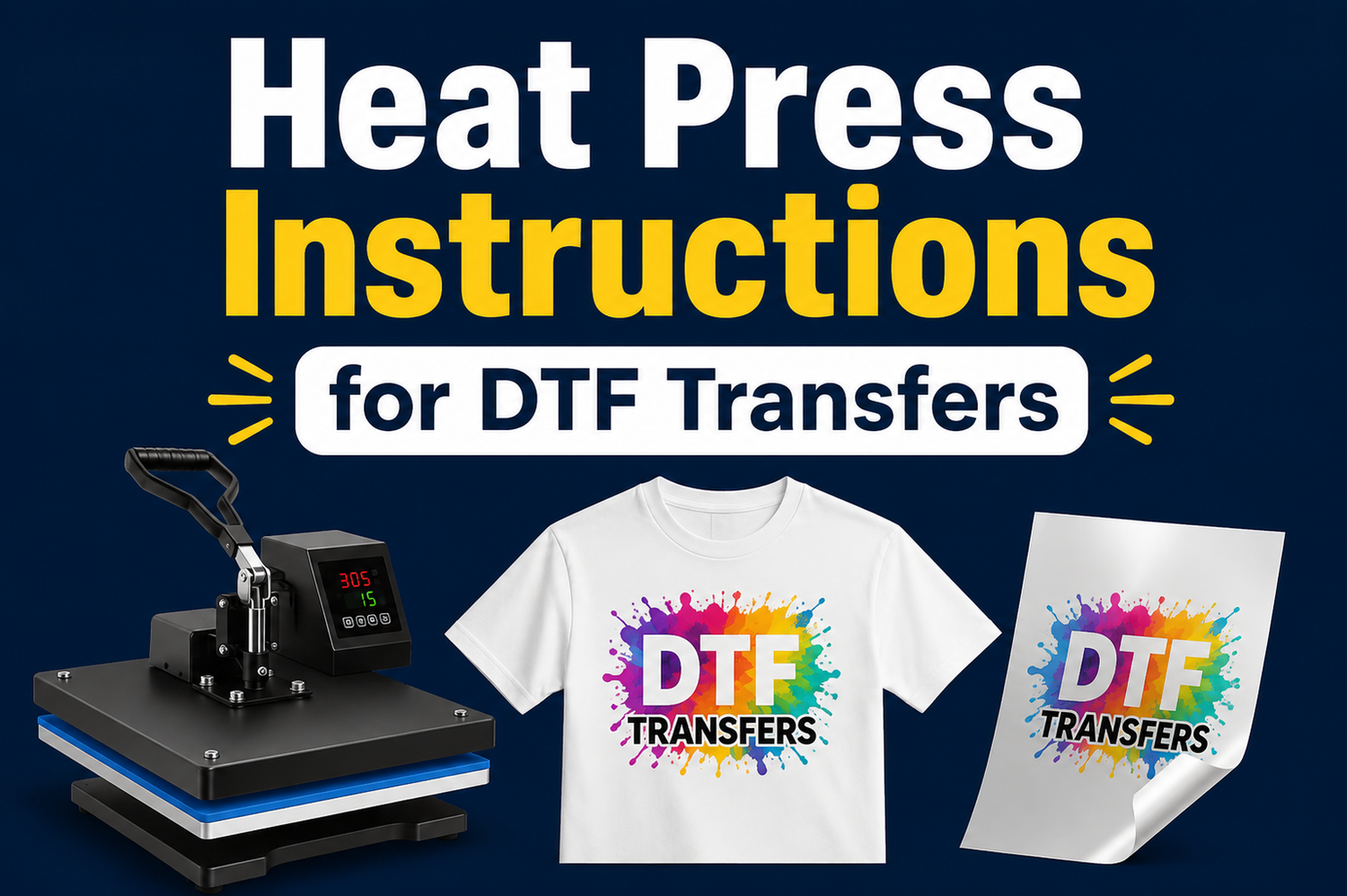
You've got your DTF transfers in hand. You've got your blank garments ready. Now what?
Applying a DTF transfer is genuinely simple but only if you follow the right steps. Get the temperature, pressure, or timing wrong and you'll end up with a transfer that peels, cracks, or washes out after a few wears. Get it right, and you've got a vibrant, durable print that lasts through 50+ washes.
This guide covers everything you need to know to press your DTF transfers perfectly, every single time.
What You Need Before You Start
Before you press your first transfer, make sure you have:
- Your DTF transfer (from Perfect DTF Transfers)
- A heat press machine (clamshell or swing-away)
- Your blank garment (pre-washed and dry)
- Parchment paper or a Teflon sheet (optional but recommended)
- A lint roller (to prep your garment surface)
That's it. No special chemicals, no pre-treatment, no complicated setup.
The Perfect DTF Transfers Pressing Settings
Every DTF transfer we ship from our Louisiana shop is ready to press using these settings:
| Setting | Recommended Value |
|---|---|
| Temperature | 280–300°F (138–149°C) |
| Time | 5–10 seconds |
| Pressure | Medium-firm |
| Peel | Hot peel (immediately after pressing) |
These settings work for most standard cotton, polyester, and blended fabrics. We'll cover fabric-specific adjustments below.
Step-by-Step: How to Apply a DTF Transfer
Step 1: Pre-Heat Your Press
Turn on your heat press and let it fully reach your target temperature (280–300°F). Don't rush this step pressing on an unevenly heated platen is one of the most common causes of inconsistent results.
Step 2: Prep Your Garment
Lay your garment flat on the lower platen of the heat press. Use a lint roller to remove any dust, lint, or debris from the print area.
Pro tip: Do a quick 3–5 second pre-press on the blank garment to remove moisture and wrinkles. This creates a flatter, more even surface for your transfer and improves adhesion.
Step 3: Position Your Transfer
Place your DTF transfer film-side up on the garment, exactly where you want the design to land. Take your time here once the transfer is pressed, it's pressed.
Not sure where to place it? Check out our DTF Transfer Placement Guide for standard chest, back, and sleeve positioning measurements.
Step 4: Cover with Parchment Paper (Optional)
Place a sheet of parchment paper or a Teflon sheet over the transfer before closing the press. This protects the film from direct platen contact and gives you a more consistent press. It's optional, but especially recommended for:
- Polyester and poly-blend fabrics
- Tri-blend heather shirts
- Any garment you're pressing for the first time
Step 5: Press for 5–10 Seconds
Close the heat press and apply firm, even pressure for 5–10 seconds. Do not lift or shift the press during this time.
The exact time depends on your press and fabric:
- 5–7 seconds for thinner fabrics (100% cotton tees)
- 8–10 seconds for thicker fabrics (hoodies, heavyweight tees)
Step 6: Hot Peel
Open the press and immediately peel the film away from the garment quickly and smoothly, at a low angle. Our transfers are designed for hot peel, meaning you peel right away while everything is still warm.
Don't wait. If you let the transfer cool before peeling, you may end up with a cold-peel result that looks different from what you expected.
Step 7: Final Press (Optional but Recommended)
For extra durability and a softer feel, do a final press:
- Place parchment paper or a Teflon sheet over the freshly pressed design
- Press again for 5 seconds at the same temperature
- Open and let cool
This second press seals the edges of the design and significantly improves wash durability.
Fabric-Specific Tips
Different fabrics behave differently under heat. Here's what to adjust for each:
100% Cotton
The easiest fabric to work with. Use 290–300°F and 7–10 seconds. Cotton can handle the heat and gives excellent adhesion.
100% Polyester
Use the lower end of the temperature range (280°F) to prevent scorching or "ghosting" (a shiny impression left by the platen). Always use a parchment sheet. Press time: 5–7 seconds.
Cotton-Poly Blends (50/50, 60/40)
A happy medium. 285–295°F for 6–8 seconds works well. Watch for any synthetic shine and use parchment if needed.
Tri-Blend (Cotton/Poly/Rayon)
Rayon is the most heat-sensitive fibre, keep temperature at 280°F. Always use parchment paper. Press 5–7 seconds.
Nylon and Performance Fabrics
Use 275–285°F and test on a scrap piece first. Nylon is heat-sensitive and some performance fabrics have special coatings that can react to heat.
Hoodies and Thick Garments
Thicker fabrics need more time for heat to penetrate evenly. Press 10–12 seconds. Make sure your platen pressure is firm.
Common Mistakes and How to Avoid Them
Transfer is peeling at the edges? You didn't press long enough, or your pressure was too light. Try pressing again for an additional 5 seconds with firmer pressure.
Design looks dull or washed out? Temperature was too low, or the press wasn't fully heated when you pressed. Always wait for your press to fully reach temperature before pressing.
Fabric has a shiny spot where you pressed? Temperature was too high for that fabric type, or you didn't use a parchment sheet on a polyester-rich garment. Use parchment and lower temp to 280°F.
Transfer wrinkled or bubbled? You didn't pre-press the garment to remove moisture and wrinkles. Always do a 3-second pre-press on a blank garment first.
Film is sticking and won't peel cleanly? Peel faster and at a lower angle. Our transfers are hot-peel if you wait too long, the film can re-adhere slightly.
What About a Household Iron?
Technically, yes you can apply a DTF transfer with a household iron. But we don't recommend it as a long-term solution.
A household iron can't deliver consistent, even pressure across the design. It also can't maintain a precise temperature like a heat press can. The result is usually uneven adhesion, especially around the edges.
If you're applying one transfer for personal use and don't have a heat press, an iron can work in a pinch. But if you're running a business, a quality heat press is a must-have investment.
Caring for Your DTF-Printed Garments
Help your customers keep their prints looking fresh with these care instructions:
- Wash inside-out in cold or warm water (not hot)
- Gentle cycle is preferred
- Tumble dry low or hang dry
- Do not iron directly on the print
- No bleach on the design area
Following these steps can extend the life of a DTF print to 50+ washes without cracking or fading.
Need Transfers That Are Actually Ready to Press?
At Perfect DTF Transfers, every order we ship from Broussard, Louisiana is printed, powdered, and cured completely ready for your heat press. Just position, press, and peel.
No minimums. Orders placed by 12 PM ship the same day. Same-day local pickup available in Broussard and Lafayette.
Order your transfers at perfectdtftransfers.com and if you have any questions about pressing, our team is always here to help.


Leave a comment
This site is protected by hCaptcha and the hCaptcha Privacy Policy and Terms of Service apply.